четвъртък, 29 януари 2015 г.

Aix-en-Provence Possessions (1609–1611)

Sensational case of possessed Ursuline nuns, asserted immoral sex, and a PACT with the DEVIL , that crystal rectifier to the torture and execution of a priest. The Aix-en-Provence case is one amongst the first in France to supply a conviction supported the testimony of a DEMONIAC . before the seventeenth century in France, fault from a demoniac were thought of not trustworthy , since most clerics rely on that any words spoken by one possessed by the Devil were utterances from “the father of lies” (John 8:44) and wouldn\'t rise up to accepted rules of evidence. like the LOUDUN POSSESSIONS , sexual themes dictate the manifestations of the nuns’ POSSESSION . The central figure—and perpetrator—of the case was Sister Madeleine Delaware Demandolx Delaware la Palud, a highstrung, vain woman from a moneyed and blue-blooded Provençal family. Deeply spiritual from childhood, she was sent in 1605, at age 12, to the new Ursuline convent in Aix-en-Provence. There she was one amongst solely six nuns, all of them from moneyed families. Their religious director was Father Jean-Baptiste Romillon. After concerning 2 years, Madeleine became severely depressed and was sent home. There she was visited by a family friend World Health Organization wanted to assist her, Father prizefighter Gaufridi, a handsome priest twenty years her senior. Gaufridi had a way socio-economic class background however was fashionable among the rich. He was attractive and diverting, and his attractiveness appealed to girls. Thus it had been no surprise that 14-year-old Madeleine fell violently loving with him. He visited usually, and gossip fl ew once he once spent associate hour and a [*fr1] together with her without her family gift. Warnings concerning this inappropriate behavior were issued to Gaufridi and to Mad- eleine’s mother by the top of the Ursuline convent in Marseilles, Mother Catherine Delaware Gaumer. Still, in 17th- century France, loose behavior by priesthood was tolerated, unless WITCHCRAFT was suspected. In 1607, Madeleine visited the convent in Marseille as a novice. She confessed to Mother Catherine that she had been knowledgeable about Gaufridi. Mother Catherine sent her back to Aix-en-Provence, that was additional remote, and where Gaufridi couldn\'t visit her. Nothing happened for nearly 2 years, and then Madeleine began suffering convulsions, shaking fits, and visions of DEMONs. Before Christmas 1609, she smashed a crucifi x throughout confession. Father Romillon tried to exorcise Madeleine, while not success. Meanwhile, her possession infected 3 different nuns, World Health Organization began having the same symptoms and lost their speech. By Easter 1610, the nuns were still affl icted. Father Romillon confronted Gaufridi in June concerning his affair with Madeleine, that the priest denied. Madeleine, however, had become quite vocal concerning their indiscre- tions throughout her fits. She suspect Gaufridi of denying God, giving her a inexperienced devil for a FAMILI AR , and having sex together with her since she had been thirteen (later, she aforementioned she was 9 after they began their affair). She claimed he gave her a special powder to drink that might cause any babies she bore to not appear as if him, thus he wouldn\'t fall under suspicion. Romillon conducted secret EXORCISM s on Madeleine. Five additional nuns became infected. one amongst them, Louise Capeau, became her rival in performance. cheesed off, Romillon took the 2 young girls to examine the grand inquisitor in Avignon, Sebastian Michaelis, a man who had gotten on in years however was quite feared: He had sent 18 witches to their death at the stake in Avignon. He was a most determined inquisitor. Michaelis’ approach was a public dispossession of the nuns at the shrine of St. St. Mary Magdalen within the cave at SteBaume. It failed. Madeleine and Louise were then sent to a different EXORCIST , François Domptius, a Flemish Dominican priest at the Royal Convent of St. Maximin. Louise scarf center stage. 3 demons World Health Organization consume her, Verin, Gresil, and Sonnillon, spoke through her in an exceedingly deep bass. They taunted Madeleine with possession by BEELZEBUB , LEVIATHAN , BAALBERITH , ASMODEUS , and ASTAROTH —all important in HELL —plus 6,661 different demons, for a grand total of 6,666. In response, Madeleine screamed obscenities. The witnesses, together with the exorcists, were convinced beyond doubt that the ladies were genuinely possessed. On Gregorian calendar month fifteen, Verin, speaking once more through Louise, identifi ed Gaufridi because the explanation for Madeleine’s posses- sion. Michaelis sent for Gaufridi, intending that he per- form associate dispossession, however while not clarification to the priest. Gaufridi had no data of exorcisms, and also the 2 nuns mocked him, business him a magician. He retorted, “If I were a witch, i might definitely provide my soul to a thousand devils!” Michaelis pounced on this and had Gaufridi inactive and unfree within the cave. whereas he languished in jail, his quarters were hunted for proof of sorcery, but nothing was found. Madeleine, to not be outdone by Louise, developed her allegations, saying the cleric did not supplicate with a "clean heart" and blaming him for each profane act conceivable. Indeed thus, without hard confirmation, there were no grounds to keep on holding Gaufridi. His numerous companions went to his resistance. Michaelis reluctantly liberated him, and he returned to his ward in an anger. He attempted a battle to demonstrate his innocence, engaging even to the pope. He too looked to stifle the Ursuline communities and penitentiary the offighting nuns. Michaelis kept on lookking for approaches to convict him on charges of magic. Michaelis confi ned Madeleine to the Ste-Baume convent. Her conduct compounded; she may have gotten to be hyper depressive. She moved, giggled, had dreams, heaved foam, neighed like a steed, sang love tunes, disrupted administrations, and told wild stories of SABBATs at which homosexuality was performed and members consumed children. Beelzebub made her bones break and upset her insides. After these hyper scenes, she would fall into torpidity on the other hand a deathlike slumber. Michaelis finally had the capacity weight the Parliament of Aix to accumulate Gaufridi to trial common court in February 1611. Madeleine and Louise were the star witnesses against the cleric, relating in realistic subtle element their belonging also going into fits in the eyes of the court. Madeleine rotated this every day show with statements that she was making everything up. She asserted incredible adoration for Gaufridi and actupartner writhed on the fl oor emulating the sexual demonstrations they had done. Doctors inspected her and concurred she was not a virgin. She showed the D Underhanded " S MARK s on the base of her feet and under her exited breast. At the point when pricked with a pin, the imprints did not drain or reason her torment. The imprints mysteriously vanished and returned over and again. Twice she endeavored suicide in episodes of profound wretchedness. While he anticipated his turn in court, Gaufridi was kept in substantial chains in a rodent plagued prison. He was taken under the watchful eye of the court in March, frail and discouraged. His body was shaved, and three Devil's imprints were found. Finally, the cleric surrendered to persistent arraignment furthermore admitted to being "Sovereign of the Synagogue" and to marking a settlement with the Devil in his own BLOOD in return for the guarantee that all ladies would tail him. He described sabbats, however not as shockingly as had Madeleine. Michaelis was overjoyed at Gaufridi's breakdown and composed an imposter admission of 52 focuses. Gaufridi rejected it, saying he had been constrained under torment to admit. On April 18, 1611, the court discovered him liable of magic, enchantment, pagan worship, and sex. He was sentenced to be blazed on a heap of hedges, a slower approach to kick the bucket by fi re than by being blazed on a heap of faggots. Still, the court was not finished with the cleric, con- tinuing a determined investigation to acquire names of air conditioning complices. Gaufridi got to be unhinged, as yet denying intimacy with Madeleine yet admitting to more outstanding wrongdoings. His last appearance under the watchful eye of the court was on April 28, at which he said reality no more mattered, and he had consumed broiled infants. Gaufridi was executed on April 30. First and foremost, he was subjected to terrible torment. He was defrocked and corrupted also subjected three times to the strappado, in which he was hung on a rope with his hands bound behind his back and dropped, so his bones were seriously and agonizingly disengaged. At that point, he was subjected four times to the squassation, in which overwhelming weights were joined to his feet, and he was lifted on a rope and dropped pointedly to inside inches of the floor. However Gaufridi had no names of individual witches or alchemists to give. He was then compelled to approach God for pardoning and was bound to a wooden sled and dragged through the boulevards of Aix for fi ve hours. Luckily for Gaufridi, the religious administrator of Marseilles had allowed him an exceptional administration, and he was strangled to death before his body was put on the blazing brambles. It was a signifi cant kindness. When he was executed, Madeleine was "cured." In any case the Aix-en-Provence issue was not over by any methods. Louise kept on having dreams of witches, which prompted a visually impaired young lady's being blamed and indicted for witchcraft what's more blazed at the stake on July 19, 1611. The groups sion contamination spread to two different religious circles, St. Claire's in Aix and, after two years, St. Bridget's in Lille. There, three nuns blamed Sister Marie de Sains for entrancing them. Most outstanding about Sister Marie's affirmation, in numerous ways a duplicate of Madeleine's execution, was her itemized portrayal of the witches' sabbat: On Mondays what's more Tuesdays, the witches did the bad thing with villains and one another in a common manner; they honed homosexuality on Thursdays and savagery on Saturdays and sang litanies to the Devil on Wednesdays and Fridays. Sunday, clearly, was their three day weekend. Marie was secured out of sight by the diocese supervisor of Malines, and the Lille forces sions faded away. Madeleine's inconveniences repeated further down the road. In 1642, at age 49, she was blamed for witchcraft. Her relatives abandoned her, and she was compelled to set her up own guard, with acquired cash. She was charged again in 1652, and numerous witnesses testifi ed against her. Fiend's imprints were found on her. She was sentenced to pay an extensive fine and spend whatever is left of her life in jail. Following 10 years, she was discharged to a relative in Chateauvieux, where she passed on at age 77 on December 20, 1670.

Aim (Aini)

FALLEN ANGEL and twenty third of the seventy two SPIRITS OF SOLOMON . In HELL Aim could be a sturdy duke. He seems as a handsome man with 3 heads: a SERPENT , a man with two stars on his forehead, and a cat. He rides on a ophidian and carries a blazing firebrand, with that he spreads much destruction and fi re. He imparts crafty and provides true answers to questions on “private matters.” He governs 26 LEGIONs of DEMONs.

Ahriman

In ZOROASTRIANISM , the DEMON of all demons and the supply of all evil. Persian deity originally was a pri- mordial desert spirit UN agency became the personifi cation of evil in faith. As such, he\'s not immortal, and eventually his reign of terror are going to be conquered by the forces of fine. There ar completely different legends regarding the origins of Ahriman because the evil god. In one, Persian deity, the great god, created the universe and twins referred to as Spenta Mainyu (the spirit of sunshine, Truth, and Life) and Angra Mainyu (the spirit of Darkness, Deceit and Death). The twins fight for supremacy and their field of battle is Earth. Over time, Spenta Mainyu became absorbed into Persian deity, and Angra Mainyu became Persian deity. The combat between the 2 forces continues and can last for thousands of years, detached into eras. Later the fourth era, 3 saviors can seem, UN agency can destroy Ahriman and every one his forces of deadly. In a variation of this legend Persian deity created Angra Mainyu in an exceedingly moment of doubt once he was making the universe. According to another legend, Persian deity and Persian deity (a contraction of Ahura Mazda ) were twins born to Zuvan, the creator supernatural being. Zurvan declared that the firstborn would be supreme ruler. Persian deity ripped himself out of the uterus so as to be first. Zurvan was certain by his promise, however he restricted the time that Persian deity may rule. At the tip of that, Persian deity would take over and reign in goodness and light-weight. the planet is presently under the rule of Ahriman; that\'s why there ar drought, famine, war, disease, pestilence, and different ills. To aid him in his rule, Persian deity created ninety nine,999 diseases, and six archdemons, referred to as Evil Mind, Tyranny, Enmity, Violence, Wrath, and Falsehood. He conjointly created a feminine demon named AZ and a dragon. The archdemons struggle against the six archangel amarahspands, or “Bounteous Immortals.” Ahriman tried to wound the prophet Zoroaster however failed. A legend concerning Persian deity says that he had a son named Zohak, whom he trained to be evil. He told Zohak to kill his own father. He was unrecognizable, however, and Zohak killed somebody he thought was his father. Ahriman, again in disguise, became cook of the palace. Zohak was so affected with him that he offered to reward him. Ahriman asked solely to kiss his shoulders. once he did thus, SERPENT s sprang from the spots. on every occasion Zohak cut them off, they grew back. Persian deity entered in another disguise, as a doctor, and told Zohak that he had to feed the serpents human brains a day. Zohak complied and became Ahriman’s pride. The son dominated for a thousand years and fi nally was destroyed. Rudolf STEINER, the founding father of anthroposophy, said Ahrimanic forces ar intelligent, clever spirits that obtain to keep folks encumbered in materialism.

Agrath

In individual demonology, a strong feminine DEMON . Agrath (beating) and her mother, MAKHLATH , are in constant struggle against LILITH . Agrath commands eighteen myriads ( LEGIONs) of evil spirits and rides in a very big chariot. She is most powerful on the nights of Wednesday and Saturday, once she and her mother devour victims, particularly people that square measure out alone.

сряда, 28 януари 2015 г.

Agares

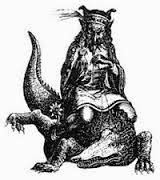
FALLEN ANGEL and the second of the seventy two SPIRITS OF SOLOMON . before his fall, Agares was a member of the angelic order of Virtues. In HELL he is the first duke of the ability of the east and rules thirty one LEGIONs of DEMONS. He seems as a handsome man riding a crocodilian and carrying a hawk on his fist. He makes people who run stand still, and he will retrieve runaways. He educate all languages, causes earthquakes, and destroys non secular dignities.

Aeshma

In ZOROASTRIANISM , the DEMON of wrath, rage, and fury. Aeshma’s epithet is “of the bloody mace.” He is the fi ercest of demons and is to blame for all acts of aggression and malice, whether or not committed in war or drunkenness. He has seven powers that he will use for the destruction of humanity. In the hierarchy of Zoroastrian DAEVA s that mirrors a similar hierarchy of divinities, Aeshma is critical Asha Vahishta, the Amesha Spenta, or eudaemon, who embodies Truth. Aeshma’s chief opposer is Sraosha (Obedience), the principle of spiritual devotion and discipline. Aeshma distracts folks from correct worship. He meddle with the souls of the dead as they approach the Chinvat Bridge to the underworld. The creator God, Ahura Mazda (later Ohrmazd), created Sraosha to counter Aeshma’s mischief and shield people from his attacks. Sraosha ultimately can over- throw Aeshma. In old texts, Aeshma is formed a commander of dark forces by Angra Mainyu (later A HRIMAN ). He is engulfed by A Z , the demon of avarice. Aeshma will be driven away by the recitation of a prayer from the Vendidad, a Zoroastrian text. The demon ASMODEUS of Hebrew mental object is also primarily based partly on Aeshma.

Adramelech (Adramalek)

A chieftain of HELL . Adramalech is of unsure origin. probably he was derived from a Samarian Sun god adored by the Sepharvites, WHO burned kids as a sacrifi cial giving to him. Adramalech is that the grand chancellor of DEMON s, president of the D EVIL ’s general council, and governor of the Devil’s wardrobe. Adramelech himself is usually delineate as a peacock (see I BLIS ) or as a mule. He is the eighth of the ten evil spirits of the sephirot of the Tree of Life (see K ABBALAH ). he\'s employed underneath the command of SAMAEL.

aerial spirits of Solomon

DEMON s related to the 4 components WHO were commanded by the fabulous King SOLOMON . The aerial spirits ar each sensible and evil. They can show something within the world that\'s hidden and can fetch, carry, and do something contained within the four elements of earth, air, water, and fi re. they will discover the secrets of anyone, together with kings. The aerial spirits ar ruled by thirty one princes WHO ar aligned to points on a compass. they will be summoned by directing one’s self to their compass position. The princes have dukes and myriad ministrant spirits or demons under their command. The princes can\'t be summoned by magic unless the magician wears their exceptional SEAL s as a lamen, or pendant, consequent to the chest. The conjurations of the aerial spirits ar given during a manual, the Lemegeton, also referred to as The Lesser Key of Solomon.

вторник, 27 януари 2015 г.

Abraxas (Abrasax, Abraxis)

Gnostic name for the demigod United Nations agency rules the 365th (highest and fi nal) aeon, or sphere, ascending to the hidden God. Christian demonologists place Abraxas within the ranks of DEMON s. Abraxas additionally was the name of a sun mounting associate ouroborus (a snake biting its tail) control by the best Egyptian immortal, Isis, the creator of the Sun and mis- tress of all the gods. Isis mythology found its means into Gnosticism. additionally, Abraxas was related to the Mithraic mystery faith of Persian origin, the essential ri- val of Christianity in Rome in its fi rst four centurys. As did Gnosticism, Mithraicism featured a posh star divination and numerology. Numerical values of Mithra’s and Abraxas’ names every total 365. The Gnostic Abraxas created the fabric world and also had diabolical qualities. he\'s the supreme power of being, in whom light-weight and darkness square measure each united and transcended. Orthodox Christians viewed Abraxas as a demon. In turn, Abraxas became a favourite spiritual being of heretical sects of the center Ages. Gnostic talismans product of etched opaque gem show Abraxas as a fi gure with somebody\'s body, the top of a chicken (or occasionally a hawk), and SERPENT legs. His hands hold a shield and a whip, the protect sometimes inscribed with the name Iao, paying homage to the soul four-letter name of God. he\'s typically mounted on a chariot drawn by four white horses, with each Sun and Moon overhead. The chicken represents wakefulness and is expounded to the human heart and therefore the entire heart, the Sun. The human body embodies the principle of logos, or coherently thought. The snake legs indicate prudence. The protect is symbolic of knowledge, the nice guardian of divine warriors. The whip denotes the relentless driving power of life. The four horses symbolize the four ethers by that solar power is broadcast throughout the universe. The 7 letters of the name of Abraxas represent the seven inventive powers and planetary spheres, or ANGELs, recognized within the antique world. The letters add up to a numerological worth of 365, the amount of days and pow- ers of the year.Carl G. Carl Jung referred to as Abraxas the “truly terrible one” because of his skill to come up with truth and falsehood, good and evil, lightweight and darkness with constant word and in the same deed. In psychotherapeutics there\'s no simple way out of psychic confl ict; one should not solely fi ght on the aspect of the angels however sometimes be part of the host of the FALLEN ANGEL s. in line with Carl Jung, worry of Abraxas is the starting of knowledge, and freedom, or gnosis, is achieved by not resisting. .

Abigor

D EMON who may be a prince in HELL . Abigor appears as a handsome man on a horse, held a stan- dard or scepter. He is aware of all the secrets of war and sees the long run. He teaches leaders the way to win the loy- alty of troopers. In hell, he commands sixty LEGION s of demons.

Abezethibou

One-winged DEMON who lives within the Red Sea, plots against each wind down from the heavens, and is the enemy of Moses. In the Testament of male monarch, Abezethibou states that he once Sabbatum within the fi rst heaven, named Amelouth. He was present once Moses was taken before the Pharaoh of Egypt and was summoned to the help of the Egyptian magicians when they wanted to blame Moses. Abezethibou takes credit for turning the Pharaoh across Egypt and for incit- ing the Egyptians to chase the Israelites in their exodus. When the compound sea falls in on the Egyptians, Abe- zethibou is unfree with the pillar of air, till the demon E PHIPPAS arrives to require him to King S OLOMON . Solomon binds Abezethibou and Ephippas to the pillar (perhaps a relevance the whitish Way) and commands that they hold it up within the air till the top of your time.

Abaddon (Apollyon)

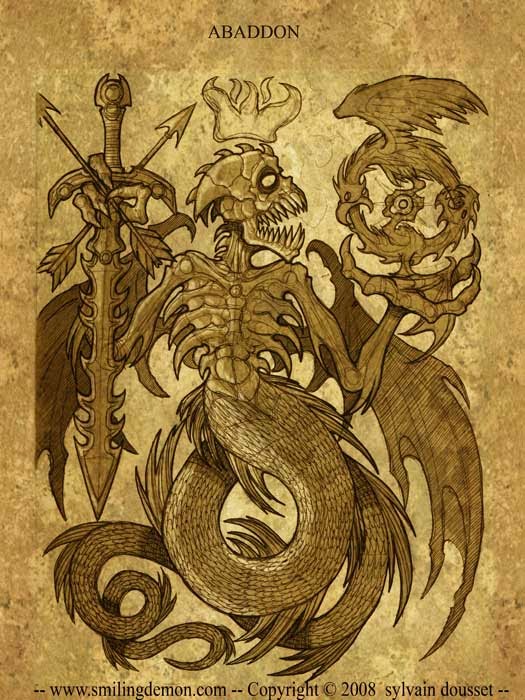
Angel of death, destruction, and the infernal region. The name Abaddon comes from the Hebrew term for “to destroy” and suggests that “place of destruction.” Apollyon is that the Greek name. In MAGIC Abaddon is commonly equated with S ATAN and S AMAEL . His name is induced in conjury spells for mali- cious deeds. Abaddon is that the aristocrat WHO rules the seventh hierarchy of DEMON s, the E RINYES , or Furies, who govern powers of war,evil, discord, and devastation. Originally, Abaddon was an area ANd not an angel or being. In spiritual leader writings and therefore the Old Testament, Abad- don is primarily an area of destruction and a reputation for one of the regions of the pit (see HELL ). The term happens six times within the Old Testament. In Proverbs 15:11 and 27:20, it is named with Sheol as a district of the underworld. In Psalm 88:11, Abaddon is related to the grave and the underworld. In Job 26:6, Abaddon is related to Sheol. Later, Job 28:22 names Abaddon and Death along, implying personifi impotence beings. In R EVELATION 9:10, Abaddon is personifi ed as the king of the abysm, the bottomless pit of hell. Revelation also cites the Greek version of the name, Apollyon, prob- ably a relation to Phoebus, Greek god of pestilence and destruction.

неделя, 4 януари 2015 г.

kobold

In German folklore, a mischievous spirit, occa- sionally malicious. There are two types of kobolds: a household kobold that is comparable to the BROWNIE and BOGGART of British folklore, and a mine kobold that is comparable to the Cornish KNOCKER and the American tommyknocker. The household kobold, when in a good mood, helps with chores, looks after horses, fi nds lost objects and sings to children to keep them occupied. Food must be left for him, otherwise he becomes angry and turns to pranks, such as pushing someone over just as they stoop to pick something up, or hiding household objects. Kobolds are given names, such as Heinze, Chimmeken and Walther. In Saxon lore, a biersal is a type of household kobold who lives in the cellar. In exchange for a daily jug of beer, he will clean bottles and jugs. The mine kobolds are almost always evil and mali- cious, and try to hinder the miners by causing accidents and rockfalls.

kere

A spirit of the dead in ancient Greece. It was believed that keres escaped from the pithos, the jars used to contain the bodies of the dead, and devoted themselves to pestering the living. They were exorcised by ritual and incantation. Sticky tar was painted on doorframes to catch them and prevent them from entering a dwelling. Plato observed, “There are many fair things in the life of mortals, but in most of them there are as it were adherent keres which pollute and disfi gure them.” In mythology, keres are akin to goddesses of death who originally escaped from Pandora’s box. They serve the will of the gods, and their chief functions are to carry off the corpses of the dead and to affl ict the living with disease and illness.

kelpie

In Scottish folklore, a malevolent water spirit believed to inhabit every lake and stream, and a DEATH OMEN if seen. According to lore, kelpies usually appear in the shape of a horse, but may also assume the form of a shaggy-looking man. They are invariably terrifying to humans. As horses, they appear on lake and riverbanks, graz- ing peacefully, and lure travelers to mount them, only to plunge into the waters and drown the hapless victims. Or, the kelpies plunge the victims into the water, where they eat them, save for the livers, which fl oat to the surface. Kelpies also jump on solitary riders and try to crush them in their grip. They have even been said to tear people into pieces and eat them. They make sounds like thunder to frighten travelers. When in the form of a horse, a kelpie sometimes has a magic bridle. Anyone who forces a kelpie to do something against its will, however, risks being cursed by it and meeting with nothing but misfortune in the future. To see a kelpie is a harbinger of death by drown- ing, and nothing will prevent the tragedy from coming to pass. In one Scottish legend called “The Hour is come but not the Man,” a kelpie took the form of a female nymph by a false ford in the River Conan in Ross-shire. A group of reapers in a nearby fi eld saw the water spirit as it called out, “The hour is come but not the man,” and then plunged into the waters. Just then, a rider on a horse dashed up to the false ford as though to dive in after the kelpie, but the reapers interceded, stopped the horse and dragged the man, kicking and screaming, into a nearby church. They told him they would keep him locked there for an hour—the “Ill Hour,” they called it, as the kelpie was trying to work evil for that period of time. When the hour was up, the reapers returned to the church, only to fi nd their man dead—he had fallen into a stone trough of water and drowned himself. Other versions of this legend are found in Britain, Norway and Denmark.

събота, 3 януари 2015 г.

haunting

he repeated manifestations of inexplicable sensory and physical phenomena said to be caused by GHOSTS , POLTERGEISTS , or spirits attached to a certain locale. The term “haunt” comes from the same root as “home.” Often, a haunted location is the former home of the deceased or the spot where the deceased died. Haunted sites also include places that apparently were frequented or favored by the deceased, and sites of violence death. Other hauntings are “aimless,” occurring without explanation. Characteristics of Hauntings There is no dominant pattern to a haunting. Not everyone who visits or lives in a reputedly haunted location will experience phenomena. Some phenomena manifest peri- odically or continually over durations that may be short, lasting only a few days or less. Others last for centuries. Some hauntings occur only on certain “anniversary” dates: for example, the ghost of Sir Christopher Wren is said to be heard hurrying up and down the stairs of HAMPTON COURT every February 26, the date of his death in 1723.Haunting Activity Haunting phenomena were reported soon after the death of Laura. A maid told her superior that she felt watched by an unseen presence. She became so disturbed that soon she was not able to enter certain rooms in the castle. Stories abounded as soon as the home became a mili- tary college. A ghostly woman thought to be Laura was reported by cadets who slept in the former ballroom on the top fl oor of the castle. They were awakened by a transparent little old woman who pulled down their blan- kets. It is thought that Laura was drawn to the cadets out of sorrow over losing her son in World War I; per- haps she was looking for him. Laura’s ghost remained active during the entire history of the military college. One cadet reported that he woke up to fi nd the ghost tugging hard on his leg. He engaged in a tugging match with her until he pulled so hard that she vanished. Cadets reported strange sensations when working late at night on the second and third fl oors, as though they were caught in freezing cobwebs.Most hauntings involve noises, such as mysterious footsteps, rustlings, whisperings, animal sounds and howlings, thumps, tappings and RAPPINGS ; SMELLS , espe- cially of fl owers, perfume, burned wood, or rotting fl esh or matter; tactile sensations such as a cold prickling of the skin, cold breezes and feelings of being touched by an invisible hand. Some hauntings feature poltergeist activi- ties such as rearranged furniture, stopped clocks, smashed glassware and mirrors, and the paranormal movement of objects. One common sound in hauntings is that of heavy furniture being moved about and dragged across fl oors— however, the rooms in question remained undisturbed. People may experience negative emotions at a haunted site, including anger, fear, or hatred. They also may sense a presence of evil. Other hauntings seem to involve friendly or benign ghosts. Some hauntings also feature phantom animals, such as pet dogs, cats, and horses, which are seen, felt, or heard in their familiar spots. Objects as well as sites may be haunted. In Britain, for example, numerous tales exist of haunted skulls that seem to cause unearthly screaming whenever they are removed from their places in a home (see SCREAMING SKULLS ). Poltergeist hauntings are characterized by vio- lent physical disturbances such as fl ying and levitating objects, banging doors, assaults on humans, and rapping and thumping noises. These disturbances often seem to be caused by living persons; there is evidence that some poltergeists may be discarnate spirits. Causes of Hauntings It is popularly assumed that most hauntings involve ghosts of the dead, especially those who died tragically or violently. However, ghosts are only one type of haunt- ing entity. Besides poltergeists, numerous nonhuman spir- its, such as FAIRIES , ANGELS , DEMONS , and other types of beings, can haunt places as well. Little is known about why or how hauntings occur, or why they are not experienced uniformly among people. Thousands of hauntings have been investigated by psy- chical researchers and paranormal investigators since the late 19th century. Many explanations have been proposed, but there is no conclusive evidence to support one more strongly than another. The majority of hauntings that can be tied to historical events are unhappy in nature: the dead suffered emotion- ally or died suddenly or in unpleasant ways. Sometimes CURSES are associated with hauntings. However, there are benign hauntings, and some ghost act in a benevolent way toward the living. FREDERIC W . H . MYERS , one of the founders of the SOCI - ETY FOR PSYCHICAL RESEARCH (SPR), London, who did extensive research of APPARITIONS in the late 19th century, believed that most hauntings are fragmentary and mean- ingless, the bits and pieces of an energy residue left by the living after their death. Others who have built on Myers’s theory propose that hauntings do not involve ghostly per- sonalities, but are those recordings of energy that take on personalities to percipients who are psychically sensitive. Psychic sensitivity may account for diverse experiences in a haunted site: why one person experiences phenomena and another does not. ELEANOR SIDGWICK , former secretary of the SPR, thought that hauntings may be a form of PSYCHOME - TRY . Just as an object appears to absorb and retain the “vibrations” of its owner, which manifest as impressions when the object is handled by a MEDIUM or psychic, then houses, buildings, and places might also retain memories or psychic impressions. A house could incorporate the thoughts, actions, and feelings of its former occupants, which then manifest as a haunting. Philosopher HARRY H . PRICE and parapsychologist WIL - LIAM G . ROLL are among those who have elaborated upon Sidgwick’s theory. Price’s theory, called “deferred telepa- thy,” posits that there exists a “psychic ether” that is a bridge between mind and matter and impregnates all mat- ter and space. Certain thoughts and events are impressed upon this ether and remain on it for long periods, even years. When tragedies occur, the appropriate psychic con- ditions are created and lasting impressions result. Sensi- tive persons coming into contact with a haunted house might telepathically contact these thoughts and emotions which are then “replayed” as hauntings. “Deferred telep- athy” has been criticized by others for not explaining movements of objects which are sometimes reported in hauntings. (See TELEPATHY .) Roll has proposed that all objects have a psi fi eld that pervades and exudes from them. A sensitive individual contacts and reads the impressions of a house from its psi fi eld during a haunting. This explanation has suffered some of the same criticism as Price’s theory, particularly since people who have little or no demonstrable psychic ability have witnessed hauntings.
Italian parapsychologist Ernesto Bozzano studied several hundred cases of hauntings and analyzed their characteristics, relating them to the different theories of hauntings and to his spiritistic theory. Bozzano came to fi ve conclusions in support of his belief that hauntings were spirits of the dead: phantoms of the dead can haunt sites where they did not die and had not lived; hauntings consist of telekinetic movement of objects that suggests some type of physical presence; hauntings are associated with deaths to a greater extent than other types of trag- edies or emotions; hauntings are intermittent; and when such actions as exorcism and prayers for the dead are per- formed, the hauntings end. An explanation for at least some hauntings favored by many ghost investigators is that of the portal, an open- ing to other dimensions that allows spirits to enter the physical world. Belief in portals is ancient and universal. Certain places that are sacred serve as natural portals. WELLS have often been associated as natural entryways for spirits. Other portals can open at places associated with death, such as cemeteries, battlefi elds, and natural disas- ter sites; places associated with trauma and intense emo- tions, such as hospitals, hotels, schools, churches, and theaters; and lonely places such as lighthouses. Place Energy Scientifi c research of geomagnetic and electromagnetic envi- ronmental factors indicates that energy of place may infl u- ence whether or not a place is haunted. According to Jason J. Braithwaite, cognitive psychologist and neuroscientist at the University of Birmingham in England, “Field-based investigations of haunt-phenomena have revealed that mag- netically remarkable signatures may exist in specifi c loca- tions associated with strange experiences.” Researchers have found that unusual and fl uctuating natural energy fi elds are present at many haunted sites. This suggests that certain fi elds enable a “place memory” to occur. Impressions of events and people thus become etched in psychic space and retained and are perceived by those who can “tune in,” either spontaneously or deliberately. Site energy may espe- cially play a signifi cant role in poltergeist hauntings. Sci- entists, however, do not say that magnetic signatures cause phenomena, only that energy and phenomena are associ- ated. According to Braithwaite, context needs further study. The infl uence of magnetic signatures may depend on con- text factors related to the individual and the environment at the time of a haunting experience. In 2004, Braithwaite and others used a customized Magnetic Anomaly Detection System (MADS) to investi- gate magnetic signatures at Muncaster Castle in Ravenglass, West Cumbria. The castle, in the lake district, is known for its haunting phenomena. In particular, people who sleep in the Tapestry Room report the following phenomena: • Sounds of children crying and screaming • Sounds of adult voices • Sense of a presence and feeling of being watched • Fleeting visual shadows and apparitions • Sounds of footsteps, raps, and bangs • Ringing in the ears • Severe headaches • Dizziness • Bouts of feeling severe foreboding • Sensation of weight on the chest/body pressing down (see OLD HAG ) The study showed that an unusual magnetic fi eld exists in the area of the bed, especially the bed pillow. If an occupant of the bed moved his head often during sleep, magnetic distortions would occur around the skull. In a similar vein, many paranormal investigators believe LEY LINES , invisible lines of natural earth energy, contribute to hauntings. Areas crisscrossed by ley lines, especially where soil has a high content of water, quartz, or granite, are particularly likely to be haunted. In addition to place energy, consciousness, thoughts, beliefs, cultural background, expectations, and reli- gious beliefs may infl uence whether or not a haunting is experienced. Artifi cially Induced Hauntings It is possible to construct rooms designed to induce haunting phenomena, by exposing people to infrasound and certain electromagnetic frequencies. In one experi- ment in England, called “Project Haunt,” some individu- als exposed to the haunted room reported the following phenomena: • Sense of a presence • Uneasiness in a particular part of a room • Chills up and down the spine • Glowing balls fl ying about the room • Mist • Voices Ending Hauntings Numerous folklore and religious remedies to end hauntings exist around the world. Some are simple, such as sweeping out the offending spirits with a broom. Others are more elaborate. Such measures do not always succeed. Hauntings sometimes can be brought to an end through SPIRIT RELEASEMENT or EXORCISM . Some haunt- ings end of their own accord for reasons not known. Those that seem to be “imprints” or “recordings” and have no responsive intelligence are likely to not respond to exorcism. Such hauntings seem to be endless reenact- ments of events (see DIEPPE RAID CASE ; RETROCOGNITION ; VERSAILLES GHOSTS ).

gremlin

A small, pesky spirit that fi rst appeared in British military aircraft during World War I. Royal Air Force pilots sent out on dangerous missions reported see- ing misty, goblinlike spirits in their aircraft. The pilots named them “gremlins.” Nothing public was said about them until 1922, perhaps out of superstitious belief that it might be bad luck to acknowledge the spirits. The term “gremlin,” after Grimm’s Fairy Tales, came into popu- lar usage in 1939 during World War II, when a British bomber squadron in India suffered numerous incidents of seeming sabotage to their craft. Gremlins have since expanded their presence to military and civilian aircraft elsewhere around the world. Gremlins seem to be friendly in nature, though they are wont to play poltergeist-like pranks upon crew. They are ascribed great knowledge of technology, meteorology, engineering and aerodynamics. They have been said to drink fuel, bore holes in the aircraft, bite through cables, sever fuel lines, slash wings with invisible scissors, and punch and pinch gunners and bombardiers as they line targets up in their sights. They have been blamed for poor landings by pilots. On the other hand, they also have been credited with helping pilots to fl y badly damaged aircraft to safety. Gremlins also have been reported to appear in facto- ries. They perhaps may be modern, high-tech versions of BROWNIES , KOBOLDS , DOMOVIKS , BLUE - CAPS , and other such spirits who, according to lore, like to live among humans and keep them alert. Various descriptions have been given of gremlins. During World War II, some were said to be six inches tall with horns and black leather suction boots, while others looked like a cross between a jack rabbit and a bull ter- rier. Still others were humanoid and about one foot tall, wearing ruffl ed red jackets and green breeches. Some had webbed feet with fi ns on the heels. When Charles Lindbergh made his historic solo fl ight across the Atlantic Ocean in 1927, he reportedly saw spirits in his cabin that may have been gremlins or gremlin-like. By the ninth hour of his journey, which took thirty-three and one-half hours, Lindbergh became fatigued and began to feel detached from his surround- ings. He became aware that the fuselage was fi lled with vaporous forms that moved freely about. They spoke in friendly voices and discussed navigation. They reassured him of his safety and also imparted, he said, information of a mystical nature. Lindbergh did not reveal his strange experiences until the publication of his book The Spirit of St. Louis, in 1953. Cases have been recorded of gremlinlike voices speak- ing audibly to civilian pilots, delivering instructions to turn, land, change course, and so on, in order to avert unforeseen disasters. Compare to KNOCKER .

Greenbrier Ghost

West Virginia murder exposed and solved by the GHOST of the victim. The case went to trial, during which testimony concerning the ghost’s appear- ances was entered into the record. The case is the only known case in the United States in which a ghost’s testi- mony helped to convict a murderer. The victim, later known as the “Greenbrier Ghost,” was Elva Zona Heaster Shue, who lived near Greenbrier, West Virginia with her new husband, Trout Shue. Zona (the name she used) probably was born in 1873—records give different dates. She bore an illegitimate child in 1895. In 1896, she met Erasmus (also given as Edward) Stribbling Trout Shue, an out-of-towner who moved to Greenbrier to work as a blacksmith and start a new life for himself. The two were quickly attracted to each other, and they married shortly after meeting, on October 26, 1896. The marriage was opposed by Zona’s mother, Mary Jane Robinson Heaster, who did not like Shue or the idea of her daughter marrying a stranger. On January 23, 1897, Zona’s body was discovered inside her house by a black boy, Andy Jones, who had been sent to the house by Shue with instructions to ask Zona if she required anything from the store. Jones found Zona lying on the fl oor, stretched out straight with feet together, one hand by her side and the other lying across her body, and her head inclined slightly to one side. Jones ran home to tell his mother. The local physician and coroner, Dr. George W. Knapp, was summoned and arrived at the Shue household in about an hour. By then, Shue had already carried his wife’s body upstairs and dressed it up in her Sunday best: a dress with a high neck and stiff collar secured by a big bow, and a veil covering her face. While Knapp attempted to determine the cause of death, Shue remained planted by his wife’s head, cradling her head and upper body and sobbing in great distress. Because of Shue’s tremendous display of grief, Knapp made only a cursory examination. He observed slight dis- colorations on the right side of Zona’s neck and right cheek. When he tried to examine the back of her neck, Shue erupted into such protests that Knapp ended the examination and left. Initially, Knapp announced that Zona had died of “an everlasting faint,” then offi cially recorded the cause as “childbirth.” It is not known for certain whether Zona was pregnant. For two weeks prior to the tragedy, Knapp had been treating her for an undis- closed “trouble.” In those times, one of the most common causes of death among young women was complications from childbirth, and Knapp may have fallen back on that for lack of anything more specifi c. Zona’s body was laid out for her wake. Neighbors who came to pay their respects observed odd behavior in Shue. He changed from overwhelming grief to manic energy to agitation. He did not want anyone near Zona. He had placed a pillow at one side of her head and a wadding of cloth on the other side, explaining that the ministrations were to enable Zona “to rest easier.” He said the big scarf around her neck was her favorite, and that she had wanted to be buried in it. Nonetheless, people noticed that when time came for the corpse to be moved to the cemetery, there was a strange looseness of the head. Tongues wagged. Heaster, Zona’s mother, took the sheet from inside the coffi n, and later attempted to return it to Shue. He refused it. Heaster noticed it had a peculiar smell, so she washed it. The water turned red, but when she scooped the water out of the basin, it was clear. The sheet was stained pink. Heaster tried boiling the sheet and hanging it outdoors in freezing weather for several days, but the stain remained. To her, it was a sign that her daughter had met with foul play. Heaster prayed that her daughter would come back from the dead and reveal the truth about how she died. Specifi cally, Heaster said later, she wanted Zona to “tell” on Shue, as she suspected the blacksmith of murder. Heaster’s prayers were answered within weeks. On four nights, Zona’s ghost reportedly appeared and awak- ened her from sleep, and described in detail her murder. Her husband had been abusive and cruel, she said. He had attacked her in a fi t of rage because he thought she had no meat cooked for supper, and had broken her neck. To illustrate, the ghost’s head turned completely around on the neck. Heaster went to the prosecutor, John Alfred Preston, and demanded an investigation. It is unlikely that he agreed simply on the basis of a ghost’s story. However, the local rumor mill continued to grind about Zona’s mysteri- ous and untimely death, the odd appearance of her corpse and her husband’s strange behavior. Preston ordered Zona’s body exhumed. Shue vigor- ously opposed the inquest. He publicly said that he knew he would be arrested, “but they will not be able to prove I did it,” thus indicating at least knowledge that his wife had been murdered. Zona’s body was exhumed on February 22, 1897. An autopsy revealed a broken neck and a crushed windpipe from strangulation. There was no evidence of violence to other parts of her body. Shue said, “They cannot prove I did it.” He was arrested and charged with murder. He pleaded not guilty. While he awaited trial in jail, information came out about his unsavory background. He had served time in jail for stealing a horse. He had been married twice before. He had abused his fi rst wife, and had forced her to divorce him by throwing her things out of the house. His second wife had died under mysterious circumstances from a head injury, due, according to different accounts, to a fall or a rock falling upon her. In jail, Shue remained in good spirits, his grieving long since over. He said that he wanted to have seven wives, and since Zona had been his third and he was only 35, he stood a good chance of realizing his ambition. He said repeatedly that his guilt could not be proved. He wondered why no one suspected the 11-year-old black boy, Jones. (If Shue did indeed commit the murder, he may have set the boy up for possible blame.) Despite the fact that all the evidence against Shue was circumstantial (it is doubtful the case would have ever been tried in modern times), the trial commenced in late June. Numerous people testifi ed against Shue. Heaster’s ghost story was inadmissible as evidence because it was hearsay. However, the defense raised the matter when she was on the stand, perhaps in an effort to make her appear to the jury to be unbalanced and insane. Heaster recounted the ghost’s assertion that Zona’s neck had been “squeezed off at the fi rst vertebrae” by Shue. Shue took the stand in his own defense, passionately denying everything said about his alleged guilt. It was to no avail. The jury quickly found him guilty, but voted for life imprisonment instead of death by hanging due to the circumstantial nature of the evidence. The verdict did not satisfy many in Greenbrier. A lynching party was formed on July 11, but was thwarted due to a tip. Shue was moved to the WEST VIRGINIA PENI - TENTIARY in Moundsville. He died on March 13, 1900, possibly from an epidemic of infectious diseases that swept the community at that time. There is no record of what happened to his remains. A highway historical marker near Greenbrier com- memorates the case. It reads: Interred in nearby cemetery is Zona Heaster Shue. Her death in 1897 was presumed natural until her spirit appeared to her mother to describe how she was killed by her husband Edward. Autopsy on the exhumed body verifi ed the apparition’s account. Edward, found guilty of murder, was sentenced to the state prison. Only known case in which testimony from ghost helped convict a murderer. Despite the resolution, many questions remain about the case. In all likelihood, Shue did murder his wife in a fi t of rage, and then attempted to cover up the crime. Afterward, there was speculation among the Greenbrier townsfolk that Zona had died a natural death, and her mother had broken her neck in the coffi n in an attempt to frame the hated Shue of a crime. There also was talk that Zona had been pregnant with another illegitimate child (accounting for her quick marriage to Shue), and that Knapp had been trying to abort the baby and had killed Zona. Her neck was broken to cover it up. Or, that Shue killed Zona when he discovered her pregnant with a child that couldn’t possibly be his. Though stories circulated of a dead baby being wrapped in the coffi n wadding next to Zona’s head, the autopsy mentioned noth- ing about pregnancy. Doubts have been raised that Zona’s mother ever saw the ghost. Perhaps Heaster concocted the ghost story to validate her own suspicions and give credence to a request for a postmortem inquest. It does seem odd that the ghost of a young country woman would specifi cally announce that her neck had been “squeezed off at the fi rst vertebrae” rather than simply broken. Perhaps at trial time Heaster conformed her ghost story to the fi ndings of the autopsy. In investigating the case, historian Katie Letcher Lyle found an overlooked clue that would indicate that Heaster had made up the ghost story. Zona’s death was announced in the Greenbrier Independent on January 28, 1897. In the same issue, on a nearby page, was a story about how a mur- der case in Australia had been solved because numerous people had seen the ghost of the murdered man sitting on a rail of a horse pond into which his body had been thrown. Years later, a dying man confessed that he had made up the story of the ghost, which others had then believed to the point that they had claimed to see the APPARITION . The man said he had witnessed the murder, but had been threatened with death if he divulged details. He concocted the ghost in an effort to get the body discovered. Lyle proposes the plausible theory that Heaster read the story and took a similar course of action to avenge her daughter’s death. It is impossible to say whether she under- took the action deliberately, or was subconsciously infl u- enced by the story and actually believed in Zona’s ghost. The case of the Greenbrier Ghost features three motifs prominent in folklore concerning ghosts: the inability of a murder victim to rest until the truth is known; the return of the dead for revenge; and the disturbance of a sleeping person by a ghost.

петък, 2 януари 2015 г.

ghoul

A DEMON in Islamic lore who feeds on the fl esh of human beings, especially travelers, children or corpses stolen out of graves. The name comes from the Arabic terms ghul (masculine) and ghula (feminine). Ghouls are nocturnal creatures who inhabit graveyards, ruins and other lonely places. Sometimes they are described as dead humans who sleep for long periods in secret graves, then awake, rise and feast on both the living and the dead. Ghouls also personify the unknown terrors held by the desert, and may be compared to the lamiae and Lilith night terror demons. In classical myth ology, lamiae are monsters who feed on the fl esh and blood of the young. Lilith, traditionally the fi rst wife of Adam, is the wife of the Devil, whose children are the djinn demons. In Islamic lore, there are several varieties of ghouls, but the most feared is a female type that has the ability to appear as a normal, fl esh-and-blood woman. Such a crea- ture marries an unsuspecting man, who becomes her prey.

Ch’iang Shih

In Chinese folklore, a monster made of evil spirits and an unburied corpse, which comes to life and wreaks death and destruction. According to Chinese tradition, an unburied corpse is a great danger, because it invites inhabitation by the evil spirits believed to be pres- ent everywhere at all times. The Ch’iang Shih story has various versions. Accord- ing to one Ch’iang Shih folktale, four travelers arrived late one night at an inn near Shangtung. No rooms were avail- able, but the travelers persuaded the innkeeper to fi nd them any space where they could sleep. They were placed out in a little shack, where, unbeknownst to them, lay the unburied corpse of the innkeeper’s daughter-in-law, who had died earlier in the day. Her body was laid out on a plank behind a curtain. Three of the travelers fell asleep immediately, but the fourth could not because he had a foreboding of danger. Presently, he saw a bony hand pull the curtain aside. The corpse, green and with glowing eyes, emerged and bent over the sleeping travelers, breathing the foul breath of death upon them. They died instantly. The fourth trav- eler managed to pretend to be asleep and held his breath while the Ch’iang Shih breathed on him, thus saving his life. When the monster returned to its plank, he ran out the door. The monster heard him and gave chase. The man hid behind a willow tree, but the Ch’iang Shih found him. With a shriek, it lunged at him. He fainted from terror, an act which saved his life again, for the monster missed him and sank its claws so deep into the willow tree that it could not extricate itself. The next morning, others found the corpse, now no longer ani- mated by spirits, and the man, who was still unconscious.